
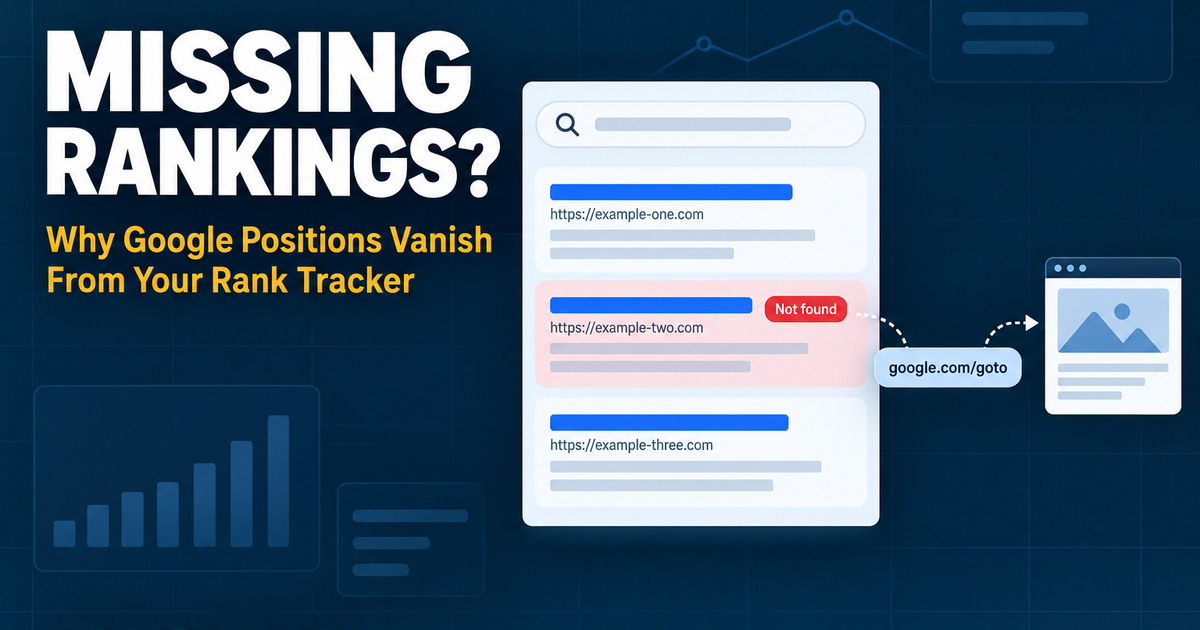
If you have opened a rank tracker recently and found a keyword that normally sits on page two showing as "not found", check something before you panic: your website may be exactly where it was. Through the second half of 2026, tools that collect Google results have been reporting missing positions, keywords that vanish from a report for a day and then return, and ranking updates that finish hours later than usual.
That is not one platform's bug, and it is not a penalty. It is the visible end of a deliberate change to the way Google serves its results page, and to what it costs to read that page from outside Google. Google confirmed the core of the change in late August 2026. Rank-tracking vendors have been adapting since, and no completion date has been published.
This guide separates the three things that get blamed on each other: the redirect Google added to result links, the removal of the parameter that once returned 100 results in a single request, and the ordinary turbulence of a spam update that rolled out in the same window. Each needs a different response, and only one of them is about your rankings.
Everything below comes from Google's own confirmation as reported by the search press, from the vendors who measured the rollout at scale, and from SE Ranking's published guidance to its own users.
Why Rank Trackers Started Showing Missing Google Rankings in 2026
Google Search began testing google.com/goto as a passthrough URL in July 2026. Instead of the anchor behind a result pointing at the destination page, it pointed at a Google-owned URL that would forward the visitor on. Search Engine Roundtable, which broke the story, described it plainly: "Google Search seems like it is rolling out the google.com/goto URL as a passthrough URL within the search results that it began testing in July 2026."
For roughly four months the change was intermittent and easy to miss. Some observers saw it in June, and the reporter who eventually broke the story could not replicate it himself as late as 8 July. Then it went broad. Derek Perkins, founder of the rank-tracking company Nozzle, reported seeing it at "nearly a 100% rollout across several residential IP providers", and published a chart showing how sharply Google's use of the format had risen across the preceding months of testing.
Google confirmed the deployment to the search press on 26 August 2026. Its entire public statement was a single sentence: "We have a long history of deploying technical measures against evolving forms of abuse, and we regularly take steps to protect our services and users."
That sentence names abuse. It does not name scrapers, SERP APIs, AI companies, or rank trackers, and no spokesperson was identified in either report. The likely reading is still hard to miss. Google sued the SERP-scraping service SerpApi in December 2025 over "circumventing security measures protecting others' copyrighted content that appears in Google search results". A judge threw out Google's copyright claims on 20 July 2026, Google said it would amend its complaint, and the redirect does through engineering what the legal route had not yet settled.
Whatever the motive, the effect on measurement is what matters here. As the SEO platform On-Page.ai, which tested the rollout itself, put it: "Rankings did not move; the measurement layer did."
What the google.com/goto Redirect Actually Changes
The mechanics are simple to describe and expensive to work around. Where a result link used to carry the destination address in its href, it now carries a Google URL of the form google.com/goto?url=[payload]. The visitor's browser requests that URL, Google's server answers with a redirect, and the visitor lands on the destination site.
What matters for measurement is the payload. It is not a readable encoded address. GrowthHasten's analysis of the change states it flatly: "The payload is opaque: the value after url= is not a readable encoded address. It is a blob." Perkins described the same thing in operational terms for Search Engine Roundtable: "The goto links can't be decoded, so providers will have to follow the redirect links."
Following the redirect is what changes the economics. A tool can no longer learn where a result points by parsing the results page; it has to request each redirect individually and watch where it lands. Perkins also warned that scale is where it bites: "While that works in small scale tests, Google seems likely to make that tough, since each SERP will have hundreds of links to decode."
On-Page.ai adds that HEAD requests, the cheap way to resolve a redirect without downloading the target page, are refused, which forces full GET requests on either the redirect hop or the destination. SerpApi, one of the larger providers in the category, confirmed the effect on its own service: "This change briefly affected some URLs returned by SerpApi... SerpApi is now returning direct destination URLs again." It also flagged a detail that explains why some tools recovered faster than others, noting that the destination could be "encoded differently depending on the result type", so a single parsing method could not resolve every variation.
Two things did not change. The searcher notices nothing, as Morris McLane's analysis puts it: "The result still displays the site's URL beneath the title; what changed is the journey the click takes, not what the searcher sees." And the destination address is still shown as plain text in the result, so a person can still tell where a link goes. What they cannot do any more is copy the real URL out of the link, and neither can a tool.
The Second Half of the Change: Google Removed the 100-Results Parameter
The redirect is the newer of two changes, and it works on top of the older one. In September 2025, Google disabled the &num=100 URL parameter that had long returned 100 results in a single request. Search Engine Journal reported practitioner reports arriving around 10 September 2025, with rank-tracking tools showing disruption almost immediately. One practitioner's summary of the effect was blunt: "If you use the parameter, only 2 pages show."
The cost implication was not subtle. One SEO platform summed up the change at the time by noting that where a single request used to return 100 results, it now took ten requests: "10x the cost."
So by the time the redirect arrived, a tool fetching a page of results was already paginating ten times where it used to fetch once. The redirect then added a resolution request for every link on every one of those pages. Neither change touched a single ranking. Both changed what it costs to observe one.
One footnote from that earlier period is worth keeping in proportion. There is a popular theory that the desktop impression spikes some sites saw in Search Console were partly inflated by SEO and analytics tools loading 100-result pages, which registered far more impressions than an ordinary search. Search Engine Journal is explicit that this is "a community theory at this stage, not a confirmed Google explanation". Treat it as a hypothesis, not as a fact about your traffic.
What It Now Costs to Track a Single Keyword
Put the two changes in sequence and the arithmetic explains the missing rankings better than any penalty theory.
On-Page.ai's reconstruction, which combines Nozzle's measured resolution range with the pagination reality, gives a progression of roughly 1 : 10 : 510-1,010 requests per tracked keyword: one request when the &num=100 parameter worked, about ten once pagination was required, and roughly ten fetches plus 500 to 1,000 redirect resolutions after the rollout. That is somewhere between 500 and 1,000 times more requests per keyword than in the earlier era, and roughly 50 to 100 times more than in the pagination era.
Their headline sentence is the one to remember: "Rank trackers now need 500 to 1,000 requests to resolve a single keyword's results."
When a provider's cost per keyword rises by two or three orders of magnitude almost overnight, something has to give, and it gives at the margins first. That is why the failures are not uniform. Deeper positions break before shallow ones, because a tool that resolves the first page of results has already spent its budget before it reaches position 60. Some keywords resolve normally while others come back empty on the same run. And some tools return a partial or delayed dataset rather than an error, which is exactly the shape of a report that says "not found" for a keyword that is ranking perfectly well.
Missing Rankings or Lost Rankings? How to Tell the Difference
A missing position in a rank tracker and a lost position in Google are different events, and there is a reliable way to separate them.
SE Ranking, whose users saw the industry-wide disruption first, documents the distinction in its help centre. The test is the saved copy of the results page attached to the ranking record in its Rankings report. Open it: if your site appears at the position the report claimed, nothing was lost, and the movement is real and correctly recorded. If the saved results page is unusually short and your site is absent from it, you are looking at a collection problem rather than a ranking change. If there is no saved copy at all, that is when it is worth contacting their support team.
The symptoms, as they show up in practice, are worth recognising:
- Keywords that normally rank beyond the first page or two show as "not found" or have no position, while the site still ranks for them when you check by hand.
- Positions update later in the day than the schedule suggests, because the collection job behind them is taking longer.
- A keyword resolves normally on one check and comes back empty on the next, with nothing changed on the site.
- A tool reports zero results for a query instead of reporting an error.
That last pattern has a mechanical explanation that has been documented during this rollout. On-Page.ai describes a verification page returning "HTTP 200 with a correct page title but an empty results container, which a parser can misread as 'no rankings'". A page that loads correctly and contains no results will always look, to a naive parser, like a keyword nobody ranks for.
It also helps to know the failure is not evenly distributed by time or by provider. On-Page.ai measured the format being served to datacenter IP addresses as well as the residential providers Nozzle monitored, and reported one scraping operator seeing blocks within hours of the confirmation, at "a ~60% block rate" on standard results pages. Vendors that adapted early, SerpApi among them, had their destination URLs back within days of the confirmation.
The August 2026 Spam Update Is a Separate Story
Running alongside all of this was a genuine Google ranking event, and conflating it with the tracking disruption is the most common mistake being made right now.
Google released the August 2026 spam update on 18 August, with the release note posted at 9:28 a.m. PDT and the Search Status Dashboard recording the incident from 9:27 a.m. Pacific. It completed on 21 August at 1:49 a.m. PDT, a rollout of 2 days and 16 hours. It was the third spam update of the year: the March 2026 update was the fastest confirmed rollout in the dashboard's history at 19 hours and 30 minutes, and June's took 2 days and 1 hour. Google published no blog post to accompany either the release note or the completion note, and announced no new spam policy types.
The practical consequence for anyone reading a ranking report today is which window they compare against. Search Console data from after 21 August gives a cleaner read than anything pulled while the update was still moving, and the weeks before 18 August are the sensible baseline. Google's own documentation notes that recovery can take months, because its systems need time to observe sustained compliance. A site seeing fluctuations should check its compliance with the existing policies rather than assume a technical fault.
Ordinary volatility sits underneath even that. SE Ranking's guidance on ranking fluctuations is worth internalising before reading any single check as a signal. Within a day, the top three and top ten are usually very stable. Positions in the 11 to 30 band tend to shift by no more than one place. The 30 to 100 band carries most of the movement, with roughly 5 to 12 of every 100 results replaced minutes apart, and pages drifting back again. A one- or two-position difference inside the top ten is normal, not a trend.
The advice that follows is to judge movement across several days rather than from a single check, and, if a top-ten position moves sharply, to verify the location using the city rather than just the country, confirm the device, and check that the language matches the project settings on a logged-out or incognito search before drawing any conclusion.
What This Means for Analytics and Attribution
Rank tracking is not the only measurement surface affected. The redirect now sits between a click and your site, and anything that relies on the browser reporting where a visitor came from has one more hop to survive.
Google Analytics does not know where a visitor came from; it infers it from a small piece of information handed over at the moment of the click. When that signal says Google, GA4 files the visit under Organic Search. When nothing arrives, it files the visit under Direct, which Google's own documentation defines as someone arriving "via a saved link or by entering your URL". Whether that signal survives the extra hop through google.com/goto is not publicly settled. As Luminest's analysis states it: "Nobody outside Google has confirmed whether that signal survives the extra hop through google.com/goto."
Their framing of the risk is the honest one: "Your website is fine. The organic traffic number in Google Analytics might not stay accurate." Nothing on the site is broken, and there is nothing to fix; what can move is a number inside a report. The precaution they suggest is cheap and worth taking now. Record two figures: your GA4 organic sessions for the last 90 days, and your total Search Console clicks for the same period. If the Direct bucket starts filling up, you will be able to see it against a known baseline instead of discovering it months later with nothing to compare against.
One surface is conspicuously unaffected. Google Search Console, which is Google's own first-party reporting, has continued to work normally, and reporting so far indicates no impact. Morris McLane draws the conclusion that follows: "The one measurement surface that keeps working is the one Google provides directly."
That is the durable lesson of all three of these changes taken together. The useful division in search measurement is no longer organic versus paid, or search versus AI. As McLane puts it, "It is measurement you own versus measurement you borrow." Search Console, your server and edge logs, and your own analytics age well, because nobody can switch them off from the outside. Scraped result feeds and referrer-dependent attribution age badly, because they exist at the platform's tolerance, and that tolerance is visibly narrowing.
What To Do While the Data Settles
Nothing here calls for rebuilding a website. It calls for a short list of habits that keep a measurement change from being read as an SEO emergency.
- Check a suspicious keyword by hand before acting on it. A logged-out, incognito search in the right city, on the right device, in the right language is the fastest sanity test available.
- Judge movement over several days, not one check. A metric that disagrees with itself between two runs an hour apart is telling you about collection, not about Google.
- Use the saved results page. Where your tool keeps one, it separates a real movement from a collection gap in seconds.
- Record your baselines. Ninety days of GA4 organic sessions and the same period of Search Console clicks cost ten minutes and give you a reference point for every attribution question that follows.
- Report a gap with the details support actually needs. For SE Ranking specifically, that means the project, the keyword, and the location, plus a saved results page if one exists. The company has published no estimated resolution date and states that its guidance page is updated as the situation changes.
- Keep first-party measurement load-bearing. Search Console, server logs and your own analytics are the numbers nobody can take away from you.
Worth adding: this is an industry-wide disruption, not a defect in one platform. Every tool that collects Google results from outside Google is affected to some degree, and the vendors that recover fastest are the ones that adapted first. Silence from a vendor during a change like this is not automatically a bad sign. A vendor that never mentions it, and never explains what it did about it, is worth a question.
Frequently Asked Questions About Missing Google Rankings
Did my website lose its Google rankings?
Almost certainly not. The most likely explanation is that the tool reporting the position could not collect the result that day. Rankings did not move; the measurement layer did. Check the keyword manually before you change anything on the site.
Why do only some of my keywords show as missing?
Collection cost breaks unevenly. Deeper positions are reached last, so keywords that normally sit beyond the first page or two are the first to come back empty. Some tools also return partial data instead of an error, which looks like a scattered set of missing keywords rather than one clean fault.
Is this affecting Bing, DuckDuckGo and other search engines?
No. The changes described here are specific to Google. SE Ranking's guidance states that other search engines and AI-search checks are unaffected, and that only Google desktop and mobile reporting is involved.
Is Google Search Console affected?
No. Search Console reporting has continued to work normally, and reporting so far indicates no impact. That makes it the most reliable reference point while third-party rank data settles.
How long will this last?
No completion date has been published, by Google or by the tracking vendors. SE Ranking's guidance is updated as the situation develops and offers manual re-checks in the meantime rather than an estimated resolution date.
Will my Google Analytics traffic drop?
It might look that way even if real traffic is unchanged. If the signal GA4 uses to classify a Google visit does not survive the extra redirect hop, some organic visits will be filed under Direct instead. Nobody outside Google has confirmed whether that happens, so record a baseline and watch the Direct bucket rather than assuming either outcome.
Should I stop using rank tracking?
No, but treat it as one input rather than the source of truth. Keep Search Console, your own analytics and your server logs as the load-bearing numbers, and use rank tracking for direction and competitive context. A single day's position has always been a noisy signal, and it is noisier than usual right now.
Is the August 2026 spam update related to this?
No. The spam update was a real Google ranking event that ran from 18 to 21 August 2026, and it is unrelated to the collection problems. They overlapped in time, which is exactly why the two get conflated. Compare against Search Console data from after 21 August and a baseline from before 18 August.
What should I send my rank tracker's support team?
The project, the specific keyword, and the location. If your tool saves a copy of the results page for that ranking record, send it too, because it is the single most useful piece of evidence for telling a collection failure apart from a genuine ranking change.
How do I tell a real ranking drop from a tracking gap?
Open the saved results page for that keyword. If your site sits at the reported position, the movement is real. If the saved page is unusually short and your site is missing from it, you are looking at a collection gap. If there is no saved copy, check the keyword manually in a logged-out, incognito search before drawing a conclusion.
Conclusion: Read the Measurement Change as a Measurement Change
The disruption in rank trackers through 2026 is the visible edge of something broader. Google has made its results page meaningfully more expensive for outside tools to read, first by removing the parameter that returned 100 results at once, and then by wrapping every result link in a redirect whose destination cannot be read off the page.
For most businesses, the practical takeaway is narrower than the story suggests. Your rankings are not the thing that changed, and there is nothing to fix on the site. What changed is the reliability of borrowed measurement, the third-party data that exists at Google's tolerance and moves whenever Google moves.
So the response is not to chase the missing positions. It is to keep a first-party baseline you trust: Search Console, your own analytics, your server logs. Check a suspicious keyword by hand before acting on it. Judge trends across days rather than hours. And when a tool reports a gap, use its own saved results page to establish whether the keyword was actually lost or simply not collected.
Platforms will keep changing how they expose their data. The measurement you own is the part that keeps working when they do.
Sources
- Search Engine Roundtable: Google Search Rolling Out google.com/goto Tracking Parameters
- Search Engine Roundtable: Google Testing google.com/goto As Tracking URLs In Search Results
- Search Engine Land: Google Confirms Deploying goto URL Redirects To Search Results Links
- Search Engine Land: The goto change and the SEO data challenge
- Search Engine Land: Google Search Confirms It Does Not Support The Results Per Page Parameter
- Search Engine Land: Google August 2026 Spam Update Done Rolling Out
- Search Engine Journal: Google Finishes Rolling Out The August 2026 Spam Update
- Search Engine Journal: Google Modifies Search Results Parameter, Affecting SEO Tools
- SerpApi: We Have Resolved the Google /goto URL Redirect Rollout
- On-Page.ai: google.com/goto Is Live - What the Black-Box SERP Breaks
- Morris McLane: Google's goto redirects and search measurement
- GrowthHasten: Google's /goto Redirect - What It Changes for SEO
- TechWyse: Google Search Redirects Could Complicate Attribution
- Luminest: Google added a stop between search results and your front door
- SE Ranking: Google rankings - missing positions for some keywords