
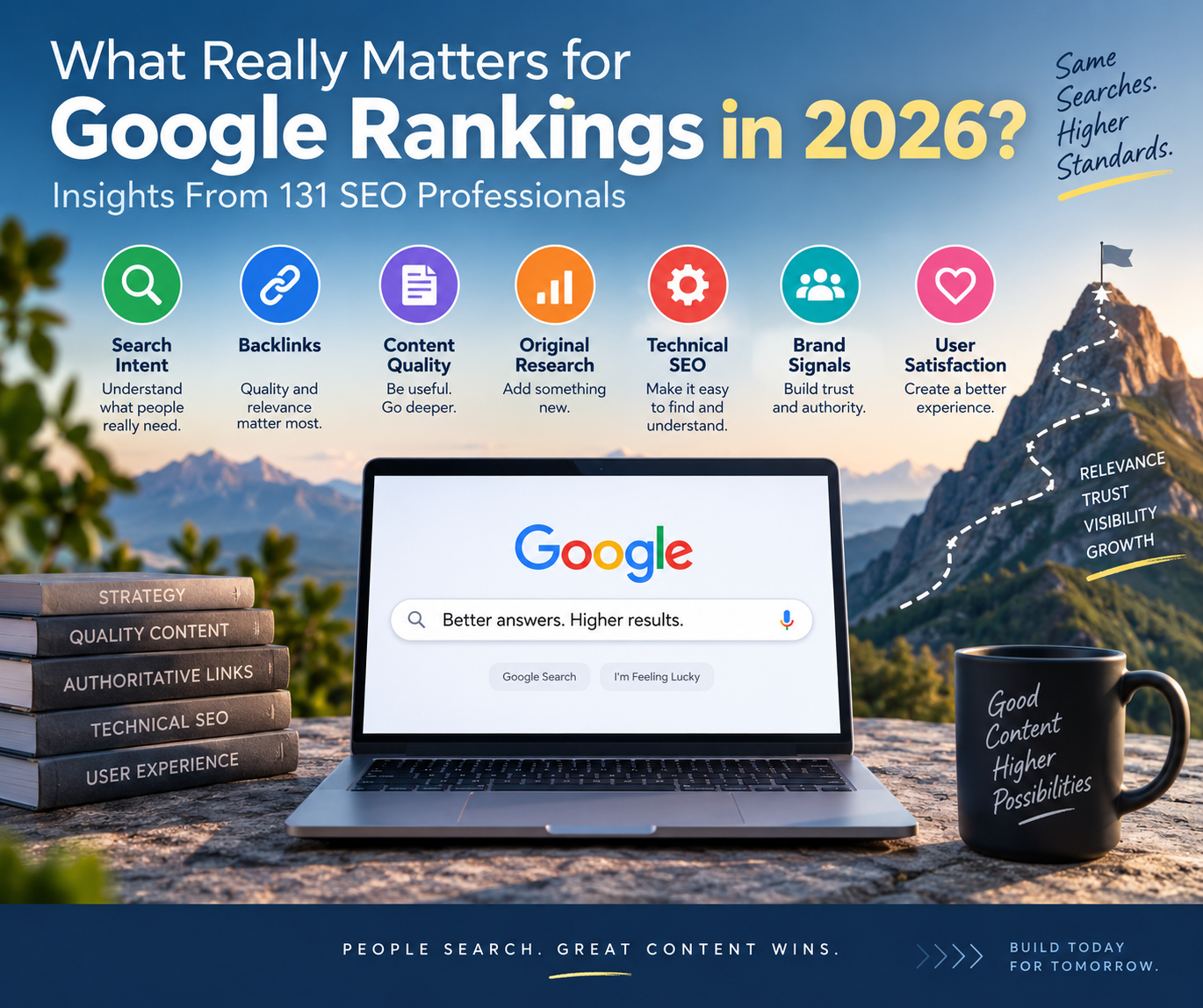
Google rankings are influenced by many signals, and SEO professionals rarely agree that one tactic can explain why a page appears above another. A new survey of 131 SEO professionals provides a useful snapshot of how experienced practitioners currently view those signals.
The survey, conducted by Zyppy, collected 13,665 ratings covering 103 potential Google ranking factors. Respondents rated individual factors on a seven-point scale and also identified the three signals they believed were most important. The results put search intent at the top, followed by backlinks and content quality.
Those findings are particularly useful because they shift attention away from isolated SEO tricks and toward a broader question: does a website consistently provide the relevance, information, authority, usability, and technical accessibility that search systems need to identify and serve valuable results?
The results also highlight an important distinction between what SEO professionals believe influences rankings and what Google officially confirms. For example, the survey ranked backlinks highly even though Google Search representative Gary Illyes has stated that links are not among Google's top three ranking signals. The survey therefore should be understood as an expert-industry snapshot, not as a definitive list published by Google.
For businesses and website owners, the practical lesson is not to chase a single ranking factor. Instead, the findings can be used to build a more balanced SEO strategy around search intent, useful content, credible links, technical foundations, brand signals, and user satisfaction.
The most effective question to ask is not simply, "How do I rank for this keyword?" It is, "What does someone searching for this topic actually need, and how can my website satisfy that need better and more completely?"
Search Intent Should Be the Starting Point for SEO
Search intent received the highest rating of any individual ranking factor in the survey. That finding reinforces one of the most important principles in modern SEO: matching a keyword is not the same thing as satisfying a search.
Someone searching for "best accounting software" may want comparisons, pricing information, feature breakdowns, or recommendations. Someone searching for "how to fix a 404 error" probably wants instructions. A person searching for the name of a local law firm may be looking for a phone number, address, reviews, or a way to schedule a consultation.
A page can contain the right keywords and still fail to satisfy the underlying purpose of the query.
This is why search intent should influence the page's format as well as its wording. Before creating or optimizing a page, consider:
- What question is the searcher trying to answer?
- What action might the searcher want to take?
- Is the query informational, commercial, transactional, navigational, or locally focused?
- What information would allow the visitor to complete the task without unnecessary searching?
- Are competing pages satisfying the query in a way that your page does not?
The survey also highlights information gain as an important consideration when several pages already satisfy the same intent. This creates an opportunity for websites to contribute something genuinely useful rather than producing another version of information that is already widely available.
Information gain might come from original research, first-party observations, detailed explanations, unique examples, proprietary data, expert commentary, comparisons, practical workflows, or other material that gives readers a reason to choose one resource over another.
For an SEO professional, this changes the content workflow. Keyword research should not end when a list of keywords has been assembled. The next step should be understanding the purpose behind those searches and determining what a genuinely complete answer would look like.
In practical terms, search intent can become the organizing principle for an entire content strategy. Keywords identify opportunities; intent determines what should actually be created.
Why Backlinks Still Matter—and Why Link Quality Matters More
Backlinks ranked second in the survey's list of perceived top ranking factors. The report states that 54.8% of respondents selected backlinks as one of the three most important ranking signals, compared with 57.1% for relevance.
The finding does not mean that every backlink has meaningful SEO value. In fact, the survey points toward an important distinction: respondents gave particularly strong ratings to links from trusted, topically relevant domains and pages that receive real visitors, while spammy backlinks were among the strongest negative signals.
That distinction matters because link building is sometimes reduced to a numbers game. A website may accumulate hundreds or thousands of links without building the type of authority that high-quality, relevant references can provide.
A more useful approach is to evaluate backlinks according to their context and credibility.
| Link consideration | Practical question |
|---|---|
| Relevance | Does the linking website or page have a meaningful topical connection? |
| Trust | Is the linking source a credible and established resource? |
| Audience | Does the page appear to attract genuine visitors? |
| Context | Does the link make sense within the surrounding content? |
| Quality | Does the link come from a useful resource rather than a low-value or spam-oriented site? |
The source report quotes Cyrus Shepard as saying that "the rumor of the death of backlinks has been greatly exaggerated." At the same time, the report explicitly notes Google's statement that links are not among its top three ranking signals. Those two observations should not be treated as contradictory proof that one side is correct. They illustrate the difference between an expert survey and Google's own public statements about its systems.
For businesses, the practical takeaway is to focus less on obtaining links at any cost and more on earning legitimate references through useful content, partnerships, public relations, industry resources, original research, and material that other websites have a reason to cite.
Link acquisition should support a broader SEO strategy rather than become the strategy itself.
Content Quality Is More Than Word Count
Content quality ranked third overall in the survey. Within that category, original research and first-party data received some of the highest ratings. That finding has important implications for websites competing in crowded search results.
Publishing a longer article is not automatically the same as publishing a better article. A 3,000-word page can still provide little value if it simply repeats information that readers can find on dozens of other websites.
High-quality content should make the reader's task easier. It should explain complicated ideas clearly, provide relevant evidence, answer reasonable follow-up questions, and avoid making the visitor hunt through unnecessary material to find the information they need.
Original research can provide a particularly strong differentiator because it gives a website information that other publishers cannot simply reproduce by rewriting existing articles. First-party data, customer observations, internal surveys, original comparisons, documented processes, and firsthand professional experience can all contribute to a more distinctive resource when presented accurately.
For organizations developing content, useful quality improvements may include:
- Adding original observations or first-party information.
- Explaining why a finding matters rather than merely stating it.
- Providing examples that clarify abstract concepts.
- Including useful tables or comparisons where appropriate.
- Answering closely related questions that naturally arise from the topic.
- Removing repetitive paragraphs that add little information.
- Making important information easy to find and understand.
The survey's findings also provide useful context for the growing use of AI-generated content. Respondents viewed AI-generated material more favorably when substantial human review was involved and when the content added unique value. By contrast, AI-generated content published at scale with little added value received negative ratings.
This suggests that the important distinction is not simply whether AI was used. The more meaningful question is what the resulting content contributes to the reader.
AI can assist with research organization, outlining, editing, ideation, and production workflows. But a publishing process that simply generates large quantities of generic pages without meaningful human contribution risks creating exactly the type of low-value content that the survey respondents viewed negatively.
Brand Signals and User Satisfaction Belong in the Bigger SEO Picture
The survey also identified notable signals within brand and user-related categories. Branded search volume, online reputation, and user satisfaction received some of the highest ratings within their respective categories.
These findings broaden the way SEO can be viewed. Search visibility is not necessarily isolated from what happens outside a website's individual pages. A business that is known, discussed, searched for, and trusted by its audience creates a broader digital footprint than a site that focuses exclusively on optimizing page titles and keywords.
User satisfaction was particularly notable. Among the user signals discussed in the report, satisfaction and task completion ranked highest, while quickly returning to Google search results received a negative rating.
It is important not to interpret these findings as a simple formula in which every visitor behavior directly produces a ranking increase. The survey reflects what SEO professionals believe about ranking factors; it does not establish that Google uses each reported signal in precisely the way respondents assumed.
Nevertheless, the underlying business lesson is valuable. Websites should be designed so visitors can accomplish what brought them there.
For a service business, that might mean making contact information, service descriptions, locations, pricing context, and consultation options easy to find. For an ecommerce site, it might mean clear product information, useful filters, transparent purchasing information, and a straightforward checkout process. For an informational website, it could mean giving readers a complete answer without forcing them through multiple unnecessary pages.
Brand development can also support SEO indirectly by making a business more recognizable and giving customers reasons to search for it by name. Reputation management, consistent branding, useful resources, and positive customer experiences therefore have value beyond their immediate marketing functions.
SEO should not be separated from the overall customer experience. A search result can earn the click, but the website still has to deliver on the promise that brought the visitor there.
Technical SEO Remains the Foundation
The survey did not portray technical SEO as obsolete. Instead, respondents gave consistently positive ratings to technical factors and generally characterized crawling, indexing, and overall site health as foundational requirements.
This distinction is important. Technical SEO may not always be the most visible part of a marketing strategy, but technical problems can prevent otherwise valuable content from being discovered, processed, or presented correctly.
A technically sound website gives search engines a better opportunity to access the pages that matter. It also creates a stronger foundation for every other SEO activity.
A practical technical SEO review should consider areas such as:
- Crawling and accessibility of important pages.
- Indexing of pages that are intended to appear in search.
- Broken links and other site-health issues.
- Internal linking between related pages.
- Logical website structure and navigation.
- Duplicate or unnecessarily competing pages.
- Page elements that help search engines understand the content.
Internal linking also received a high rating in the survey. This is especially useful for larger websites because internal links help connect related pieces of information and establish relationships among pages.
For example, a local business website might connect a main service page with supporting educational articles, location pages, frequently asked questions, and related services. A well-planned internal linking structure helps visitors navigate the site while also making the site's topical organization clearer.
Technical SEO should therefore be viewed as infrastructure rather than a one-time checklist. Websites change. New pages are published, old URLs are removed, templates are redesigned, plugins are updated, and navigation structures evolve. Periodic technical reviews can identify problems before they undermine otherwise successful content and authority-building efforts.
The survey's message here is relatively straightforward: content and links cannot compensate for a website that fundamentally prevents important pages from being crawled, indexed, or understood.
What SEO Professionals Should Do With These Findings
The survey is most useful when its findings are translated into an actionable workflow. Rather than treating the reported factors as a checklist of isolated ranking tricks, businesses and SEO professionals can use them to evaluate whether their websites are delivering a complete search experience.
- Start with search intent. Identify what the target audience is actually trying to accomplish. Build the page around that purpose instead of beginning with keyword repetition.
- Look for opportunities to add information gain. Determine what your page can provide that competing resources do not. Original research, first-party data, expert experience, examples, tools, comparisons, and practical explanations can make content more distinctive.
- Improve content quality before scaling production. Establish standards for accuracy, usefulness, originality, editing, and reader experience before increasing publishing volume.
- Build relevant authority. Pursue legitimate opportunities to earn links from credible and contextually relevant websites. Avoid treating backlink quantity as the primary objective.
- Strengthen internal linking. Connect related pages in a way that helps visitors discover useful information and makes the site's topical relationships easier to understand.
- Audit technical foundations. Regularly review crawling, indexing, site health, broken links, and other technical issues that could prevent important pages from performing properly.
- Measure the user experience. Look beyond rankings. Examine whether visitors find what they need, complete important actions, contact the business, purchase products, or otherwise accomplish the purpose of the page.
- Develop the brand. Treat reputation, recognition, and customer experience as part of the broader search ecosystem rather than limiting SEO to on-page optimization.
This approach also helps prevent overreaction to individual industry surveys. Ranking systems are complex, and a survey of professionals represents informed opinion rather than a complete disclosure of Google's algorithms.
The survey itself collected ratings across 103 potential factors, which illustrates just how broad the field is. A sustainable SEO program therefore needs to balance relevance, content, authority, technical accessibility, and user experience rather than betting everything on one signal.
For website owners, this can be reduced to a simple sequence: understand the searcher, create something genuinely useful, make it technically accessible, establish credibility, and continuously improve the experience.
The SEO Factors That Matter Most Are Connected
One of the most useful ways to interpret the survey is to recognize that its major findings are interconnected rather than independent.
Search intent influences content quality because understanding the searcher's goal makes it easier to determine what information belongs on the page. Content quality can create information gain, which can make a resource more useful and potentially more worthy of being referenced by other websites. Strong content and useful resources can contribute to brand recognition and reputation. Internal links can connect those resources into a coherent site structure. Technical SEO makes the entire system accessible to search engines and users.
Backlinks also fit into this broader picture. A genuinely useful resource may naturally attract attention, references, and links because it provides something worth citing. That is fundamentally different from treating links as an isolated commodity.
Consider a hypothetical local professional-services website. Instead of publishing dozens of nearly identical pages targeting variations of the same keyword, the organization could build a structured resource around the problems its customers actually face. A central service page could explain the offering, supporting articles could answer common questions, original material could provide additional insight, location pages could address genuine local relevance, and internal links could connect the resources.
That strategy addresses several of the survey's themes simultaneously.
The same principle applies to ecommerce, publishing, SaaS, healthcare information, finance, education, and other industries. The exact content will differ, but the underlying process remains similar: identify the user's purpose and build a website capable of fulfilling it.
This is also why SEO strategies that focus exclusively on one metric can become fragile. Rankings may change, competitors may improve, algorithms may evolve, and individual signals may be interpreted differently over time. A website built around genuinely useful information, sound technical foundations, credible authority, and satisfied users has a broader foundation than one built around a single tactic.
The survey provides a current snapshot of professional opinion in 2026. Its greatest practical value may therefore be as a reminder that effective SEO is increasingly holistic: relevance and usefulness come first, while technical, authority, brand, and experience considerations support the overall system.
Frequently Asked Questions About Google's Ranking Factors
What did the 2026 Zyppy survey say was the most important Google ranking factor?
Search intent match received the highest rating among the individual ranking factors evaluated by the 131 SEO professionals surveyed by Zyppy.
Are backlinks still important for Google rankings?
Backlinks ranked second among the top three signals selected by survey respondents, with 54.8% choosing backlinks. However, the report also notes that Google representative Gary Illyes has said links are not among Google's top three ranking signals. The survey therefore reflects SEO professionals' views rather than an official Google ranking-factor list.
Does having more backlinks automatically improve rankings?
No such conclusion can be drawn from the survey. Respondents gave strong ratings to links from trusted and topically relevant domains and pages with real visitors, while spammy backlinks received negative ratings. The quality and context of links matter to the findings.
What role does search intent play in SEO?
Search intent describes the underlying goal behind a search query. The survey ranked intent match highest among individual factors, emphasizing the importance of creating pages that actually satisfy what the searcher is trying to accomplish.
Is longer content better for SEO?
The survey ranked content quality highly, but it does not establish that word count itself is a ranking advantage. Quality is better understood in terms of usefulness, relevance, originality, and the ability to satisfy the searcher's needs.
Is AI-generated content bad for SEO?
The survey respondents viewed AI-generated content more favorably when it received substantial human review and added unique value. AI-generated content produced at scale with little added value received negative ratings. The findings therefore distinguish between the use of AI and the quality and originality of the resulting content.
Why is original research valuable?
Original research and first-party data received some of the highest ratings within the survey's content-quality category. Original material can provide information that is not simply another restatement of widely available information and can contribute meaningful information gain.
Does technical SEO still matter?
Yes. Technical SEO factors received consistently positive ratings in the survey, with crawling, indexing, site health, and internal linking described as foundational considerations. Technical accessibility allows valuable content to be discovered and processed effectively.
Do meta descriptions affect Google rankings?
Meta descriptions ranked near the bottom of the survey, and most respondents said they have little or no direct effect on rankings. They should therefore not be treated as a primary ranking lever based on these findings.
What should a business prioritize after reviewing these findings?
A practical approach is to begin with search intent, improve the usefulness and originality of content, maintain strong technical foundations, build credible and relevant authority, develop internal links, and pay attention to whether visitors can successfully accomplish what they came to the website to do.
Conclusion: Build for Relevance, Usefulness, and Trust
The 2026 survey of 131 SEO professionals offers a useful snapshot of how experienced practitioners currently view Google's ranking factors. Search intent ranked first, backlinks ranked second, and content quality ranked third. Original research, first-party data, relevant and trusted links, brand signals, user satisfaction, technical SEO, and internal linking also emerged as important themes.
But the findings are more useful when viewed as a connected system rather than a ranking-factor scorecard.
A website cannot create genuine search relevance simply by inserting keywords. It cannot build sustainable authority by collecting random backlinks. It cannot create content quality merely by increasing word count. And it cannot deliver a strong search experience if important pages cannot be crawled, indexed, or navigated effectively.
The practical opportunity is to build websites that deserve to be found.
Understand the searcher's objective. Give them useful and distinctive information. Add original value where possible. Make the website technically sound. Earn credible references rather than chasing links indiscriminately. Build a recognizable and reputable brand. Most importantly, make it easy for visitors to complete the task that brought them to the site.
Those principles provide a more durable SEO framework than trying to identify one secret ranking signal.
For businesses that want to turn these principles into an ongoing SEO process, the next step is to audit the website from the perspective of search intent, content usefulness, authority, technical health, internal structure, and user experience—and then prioritize the gaps that offer the clearest opportunities for improvement.